
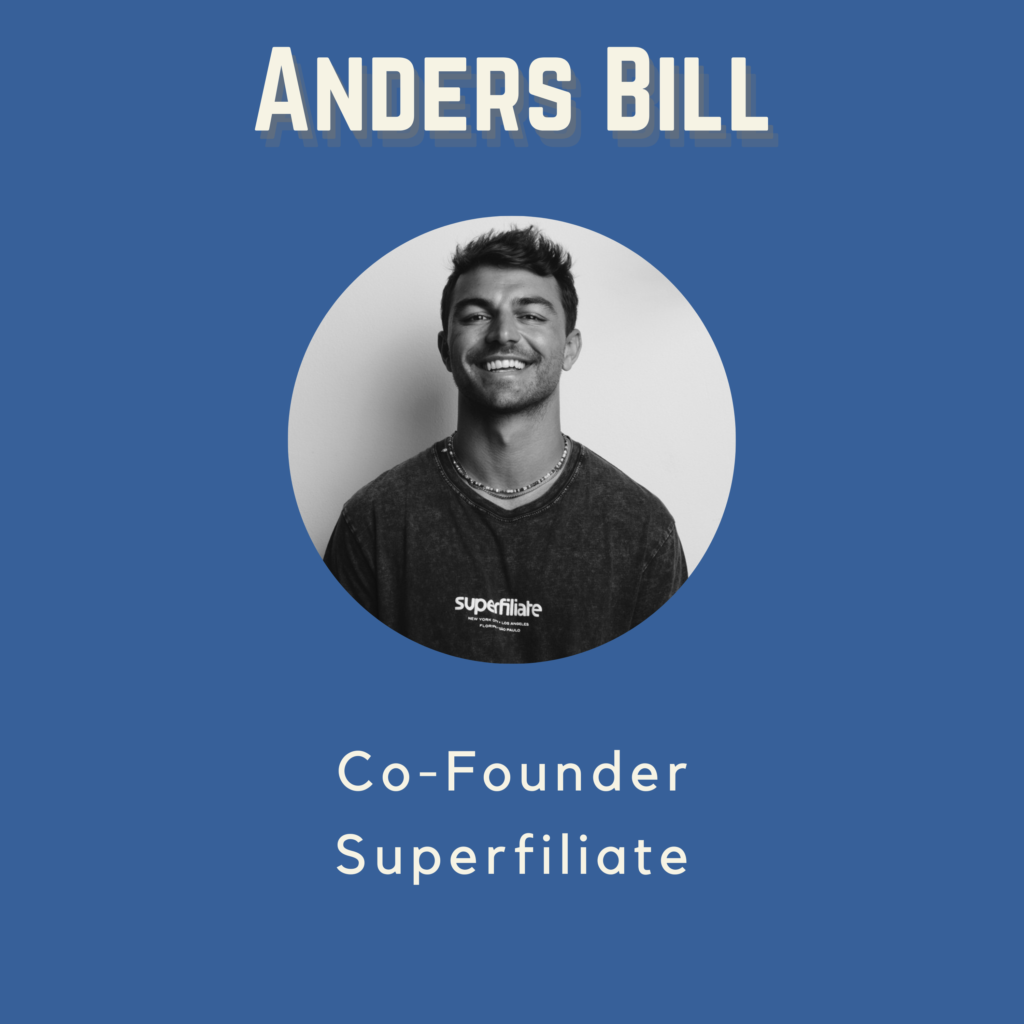
Summary
In this episode of Performance Marketing Spotlight, Anders Bill, co-founder of Superfiliate, joins Marshall to break down the evolution of the creator economy and how brands can effectively scale creator marketing today.
Anders shares his entrepreneurial journey—from building on the early Spotify ecosystem (and learning hard lessons about platform risk) to scaling a marketplace for photographers, and ultimately co-founding Superfiliate. He dives into how creator marketing has expanded far beyond traditional affiliate into a multi-channel growth engine that includes paid partnerships, TikTok Shop, and creator-led advertising.
The conversation also explores the importance of authenticity in influencer marketing, why consumers are more discerning than ever, and how AI should be used to enhance—not replace—relationship-driven marketing. Anders also discusses Superfiliate’s latest product innovations, including tools designed to streamline flat-fee partnerships and campaign management.
This episode is a deep dive into where the creator economy is headed—and why brands that embrace its growing complexity will have the biggest advantage moving forward.
About Our Guest
Anders Bill is the co-founder of Superfiliate, a creator marketing platform helping brands turn creators into scalable growth engines across affiliate, paid partnerships, and emerging channels like TikTok Shop. Based in Los Angeles, Anders has spent the past decade building companies in the creator economy, from early experiments in social music platforms to scaling a marketplace for photographers to monetize their work. At Superfiliate, he focuses on bridging the gap between creators and commerce by building tools that enable brands to run sophisticated, multi-channel creator programs.
Transcript
Marshall Nyman [00:00:01]:
Hello and welcome to the performance Marketing Spotlight. I’m your host, Marshall Nyman, founder and CEO of Naimon Co. Each episode I will be bringing you someone with deep experience in the performance marketing space where they share their career journey and insights about the industry. Today I have Anders Bill of Super Affiliate. Welcome to the podcast. Anders.
Anders Bill [00:00:21]:
Marshall. How we doing, man?
Marshall Nyman [00:00:23]:
Awesome. Excited to have you on. Let’s get right to it. Can you briefly introduce yourself to the audience?
Anders Bill [00:00:29]:
Of course, yeah. My name is Anders, obviously. I live in Los Angeles. Currently the co founder of Super Affiliate.com, which is essentially like a creator marketing platform. And yeah, just been building companies in the creator economy for the last decade or so, which has obviously changed so much. Sometimes it’s weird to say a decade because, you know, it just doesn’t feel like that. Maybe I’m in denial over here, but yeah, I’ve just loved building companies for creators and brands and businesses. I’ve seen so many different iterations of different companies in the creator economy, affiliate world, influencer world, and I’m excited to talk about it today.
Anders Bill [00:01:07]:
It’s just not one thing and it’s so many subcategories. So, yeah, I’m stoked to talk about it today.
Marshall Nyman [00:01:13]:
Well, tell us a little bit how you got started in your first venture.
Anders Bill [00:01:16]:
Yeah, so I was, I think I was 18 in Boston College and was just seeing the world of technology and technology companies and just trying to understand what I could build in the space. And then found a couple of guys in Boston College who were older than me who we started creating a company actually that was called Echo Me. It was really around basically empowering artists, athletes, celebrities to stream their music live. This sounds like a really funny concept in some ways because the Spotify API at the time was actually open so you could build on the Spotify ecosystem. For anyone that remembers, there was something called the Echo Nest. And if there are any of these OG Spotify users, they were actually apps in Spotify. And then we were building as one of those apps where if you’re a Lebron James in the locker room before the NBA finals, you could stream your music and then anyone could jump into your stream. And so it was meant for people that wanted to work out together or hang out together or be connected across the world.
Anders Bill [00:02:15]:
And it was kind of like turning everyone into a creator in some way. But maybe creator is the wrong word here. I think in a lot of ways it was just around connecting people through music and really were just fascinated around what music would do for people, especially when they’re in person, but knowing that they’re at a distance, but listening to the same song at the same time. And so that was the experience at Echo Me. We built like a huge creator collegiate program where we had a bunch of college students who were really promoting us. And then ultimately the Spotify team closed their ecosystem, which was just the most cruel lesson in platform risk ever, where you’re 100% really dependent on an API or a platform and then the ecosystem just 100% closes and then they start building their own things like Spotify Jam and those types of things. So you’ll see ecosystems like Shopify are very open. But then an ecosystem like Spotify, you don’t even think of it like an ecosystem today because they’ve actually closed it and in house to everything.
Anders Bill [00:03:13]:
So that was a great lesson for us in just building software.
Marshall Nyman [00:03:18]:
So that was probably a pretty tough moment. And then so from there, where do you go? What happens next?
Anders Bill [00:03:24]:
Then I met my co founder for my second venture, which was this guy named Theo, who was just like an awesome photographer who saw a really cool opportunity in the space, really around photographers as creators and just how photographers were struggling to sell their physical work. So it was 2016 at the time, and if you were a photographer, you either could sell your work in galleries, but that was all physical. And maybe they had a digital presence and it was only for the top, top people. Or you could try to sell on one of these marketplaces where you know, you’re selling your fine art next to phone cases, you know, you were maybe traveling around the world or working for Nat Geo or Vice or one of these platforms where you’re taking photography, many different styles of photography, of course, but selling your work and monetizing it at a physical form was really hard. And so we built kind of the digital platform where you could just upload your work and then in two or three minutes have kind of your art ready to be sold. And once the orders came in, you didn’t have to do any of the work, right? As, as we learned is that these creators are really great at doing their craft, right at doing the photography or the videography or the graphic design, but doing the infrastructure for actually selling their work, which includes the digital website set up, which includes the infrastructure manufacturing was also challenging and we wanted to make it really turnkey. And what we would do is go to the biggest providers of this physical art in the country and say, hey, we’re going to bring huge amounts of volume to you. We want to negotiate bulk distributor Deals that we then pass on to the creator and artist.
Anders Bill [00:04:57]:
And we scaled that up to, I think, like 100,000 artists or so. And Theo’s still running that company today. It’s just awesome. It’s like really serving a really specific niche in the photography community specifically. And, yeah, it’s just a great place where people can go and sell their art. And that’s actually, I think the segue probably to what I’m working on today is I think I felt at five years in, I was ready for kind of like the next step in the creator economy, where I think Theo was so talented as a photographer himself and so embedded in that creative community, and I was less so. And I think I wanted to kind of broaden the aperture to the creator class that we were serving at the software level. And that’s ultimately what drove us to start Super Affiliate.
Marshall Nyman [00:05:39]:
So how did you originally meet Andy?
Anders Bill [00:05:41]:
Andy, who is my co founder, who is a hilarious human being. And Andy, if you’re listening to this, I will not tell any, any stories. The way we met is actually as random roommates in Los Angeles. This is crazy. So we needed to fill. Me and a few other friends were trying to rent a house. We’d all been living in shoebox apartments. I had a very, very small window in the studio apartment, and I was just knowing that I needed to get out.
Anders Bill [00:06:09]:
And so I found this house for us to move into. And we had someone fall off the lease at the last second. And we had a day to fill the lease. And a friend of ours, everyone else was super nonchalant and I was freaking out, obvious, because we needed to fill this lease in such a short period of time. And my other roommates at the time were super relaxed. Anders were going to find someone, and a friend of ours goes out to dinner or something along those lines and bumps into Andy. Doesn’t know who Andy is, but gets introduced and then basically asks him if he wants to move in with us the next day. And Andy was working for Rise of the Rest, which was Steve Cage, the founder of AOL’s venture fund, and had to move to Washington D.C.
Anders Bill [00:06:55]:
in a few months. And so he thought this could be interesting. And the next day, Andy shows up to the house where we’re about to show him the place before he confirms. And the house is locked. And we have to get Andy to get to the master bedroom because no one can afford the master bedroom. And without seeing the place, Andy says, give me an hour. And he went to breakfast around here in Venice and then texted all of us, he said, I’m in. And that was what started all of it.
Anders Bill [00:07:23]:
And Andy, we had met him for an hour. He seemed normal enough, of course. And that was really what kicked off Super Affiliate. And then Super Affiliate was really formed in the house that we were living in where we were just kind of looking at the creator economy. I was kind of thinking about what was next for me. And I remember just writing out what Super Affiliate could be on a piece of paper. And it was really a totally different concept, but it was more around building in the Shopify ecosystem, but within turning customers into your creators. But how far could that go? And I remember hearing Andy talking on the phone and I was looking at him and I was thinking, he’s such a good CEO and I do not want to be CEO.
Anders Bill [00:08:05]:
I think he’d be an amazing co founder for this company. So I asked him, do you want to be the co founder of this company that I’m starting? And this is roughly what it is. And I showed him the piece of paper. It’s like this little yellow piece of paper. It took a little bit of convincing, but he ultimately was ready to jump in and start the company.
Marshall Nyman [00:08:25]:
So you basically just fell into some type of incubator.
Anders Bill [00:08:29]:
Exactly, exactly.
Marshall Nyman [00:08:31]:
Well, it was meant to be. So you two have started Super Affiliate. Tell us a little bit more about what Super Affiliate is and what makes it unique.
Anders Bill [00:08:41]:
So Super Affiliate has obviously changed so much over the last five years. I guess we’re a little bit younger than five years now. But we fundamentally are a creator marketing platform that is really built for brands that are looking to turn creators into really a big growth engine for their business, but who also recognize that creator marketing is not one thing. Creator marketing has many different sub verticals in it and we service a handful of those sub verticals. So some of the sub verticals we service are affiliate marketing. So very traditional. And I mean creator Affiliate here, not publisher affiliate. Creator affiliate being working with creators on a commission capacity where they get a link and code to certain products or to the whole website.
Anders Bill [00:09:26]:
And they’re obviously promoting some discount. They receive some commission, either flat fee or percentage in return. And that was kind of where we began in building best for you affiliate programs. We also created this concept of the co branded landing page where our thesis was every affiliate link just drives to the website. We wanted to drive to a co branded landing page where the creator is embedded in the commerce experience. That was super effective. It really differentiated us in the market. Then we broadened out into other sub Verticals including creator led advertising, TikTok shop and now flat fee partnerships.
Anders Bill [00:10:08]:
All of those sub verticals really have a different product suite within Super Affiliate where you can use our product in a very different way to service the needs and goals of what it is to run a Flat fee program versus an affiliate program versus TikTok shop versus doing a creator led advertising campaign like running partnership ads on Meta. We service some of the top companies that are in the Shopify ecosystem today, but now even broader, just in the broader commerce space today. And yeah, we’re about a team of 80 around the world, a very heavy presence in Brazil from the team side. And yeah, that’s kind of the TLDR for what Superfluid is.
Marshall Nyman [00:10:49]:
I love how the products evolved and when we first got started working together, I love the landing page idea just because so many people just were getting dumped on the homepage. And so to really just create like a unique experience for someone’s dedicated audience I think really stood out. And to see some of the evolution of some of the additional products has been really cool. Any new product releases on the roadmap that we should be maybe hearing about?
Anders Bill [00:11:16]:
Yeah, 100%. So we just released our Super Brief. We basically have been working on this for the last six or nine months, which was really opening up our platform to be accessible for flat fee partnerships. You could run flat fee partnerships before on Super Affiliate, but it really required, in my opinion, a dedicated product suite that serviced the needs of that end user in a unique way. Where in a flat fee program you don’t want everyone to get in, you don’t want it to be kind of a rolling acceptance, you don’t like, you just treat the creators in such a different capacity. And so the Super Brief is this programmatic brief where it does a little bit of everything that you would want to do between nine different tabs that you would be using to actually manage a Flat feed program, where you would have in the past been shifting between Gmail and Google Sheets and maybe a different data provider. And just trying to understand where the creators are at in the funnel within a Flat Feed program is so hard. The Super Brief is this intelligent campaign infrastructure where you can recruit creators.
Anders Bill [00:12:27]:
You can put them in the brief, you can automatically give them product, you can track their social posts, you can give them links and codes. If you want to track their conversions, you can measure how they perform on social, you can see what stage they’re at. Hey, this creator delivered you the content, but they haven’t posted it yet or they’ve posted the first two pieces of content, but not the third. And here’s how it’s performing. This gives you a holistic way to run flat fee partnerships. And so we’re super stoked about the super brief launch and I think it really broadens the addressable market that we are existing in today.
Marshall Nyman [00:13:02]:
Sounds like a great addition to the platform. What’s been one of the most exciting parts of launching Super Affiliate for you?
Anders Bill [00:13:09]:
For me, the most exciting part was there’s been a few. I think at the end of the day, our team. This is going to sound trite or cliche. Genuinely, the amount of excitement I get from our team feeling like they are doing the work that they’ve dreamed of with the people they’ve dreamed of doing it with, is one of those types of fulfillment and satisfaction that it’s not dopaminergic. You’re not hitting this milestone or this revenue goal or this product launch. It’s an internal ethos and it’s a larger sense of purpose that I feel and I think it’s something that I’m trying to continue to connect with at more of an emotional, just psychological way where the journey is not to build this business so that you can sell it or ipo. It’s fundamentally to be around people that you love to be around. And those other things come as a result of that.
Anders Bill [00:14:08]:
And so for me, the most exciting thing is seeing that we’ve created an environment where the people at our company feel like they’re doing the work they want to be doing with the people they want to be doing with. And I think it’s one of those things where if you’re going to throw a party, throw a party that you want to be at. If you want to have a dinner party, cook the food you want to eat. I think very similarly. And this has been by chance and I think a lot of luck, but it’s also been some amazing key hires we made in the beginning. The culture has just created itself and the people, it’s really been bottoms up, I’ll say that. Where the people have really become the culture and Andy and I get to just experience that. And that has been the best part of the journey by far.
Marshall Nyman [00:14:53]:
I love hearing that because that really strikes a chord with me because that’s the way that we really operate our business as well. And I get asked this question a lot and it sounds like you probably get asked the same question a lot as, what’s the end for you? Are you trying to sell the business? What’s your goal. And I’m always just like, I’m just having fun. I like working with the people I work with. I like creating the experience that we have. And so it sounds like you guys are doing something very similar, and I really respect that. I think that’s really important.
Anders Bill [00:15:24]:
There’s this line that we have too, that is, you can’t. I think it comes from. Obviously comes from somewhere, but the line is, you can’t compete with people who are having fun. And of course it sounds cliche, but it’s so true. What do we have to lose? We’re just continuing to do what we want to do every day. So, yeah, it’s been a very humbling change. If you asked me five years ago, that would have been important, but it wouldn’t have been the most important cornerstone of what this experience has been.
Marshall Nyman [00:15:54]:
And being in the influencer marketing space is just a fun place to be as well. And what do you think for you, what excites you most about being in the influencer marketing space?
Anders Bill [00:16:04]:
Yeah, I think there’s a couple of things I think about here where I believe consumers are getting so smart that they understand whether or not a creator actually cares about a product or not. And that’s an interesting tipping point for the creator economy, because you go from this space where anyone could sell anything to anyone, to a place that’s way more authentic. It’s way more around, hey, does this creator actually find value in the product? And is their life actually better from this? And then the consumers having to discern whether or not that’s actually true in their content, and then to bring that product into their life to see if it makes a similar change. Because the products that a lot of us want to have today change the way we feel and act and how our bodies work, whether it’s in the health, wellness, supplements, lifestyle space. I think about it as selling new habits that we want to have in our lives. And what makes me so happy is that the consumer is smarter than they’ve ever been, which means the demand and the pressure is on the companies to create really high value, meaningfully significant innovations within their verticals that are backed by science or have enough clinicians like, whatever. I’m just talking more in the health and wellness space, but they have some real backing to them that can genuinely change people’s lives. And so, yeah, I feel really excited about it.
Anders Bill [00:17:36]:
I think if you asked me 10 years ago, I would have been more worried to operate in this type of an ecosystem where it feels more like materialism. And perpetuating products that people don’t know if they really work. I just think the discernment of the end user is so good now. And then the trust that a creator can lose if they really betray their followers with what products they’re endorsing is a real risk for them. And so I think we’re at a really cool place in the creator economy where the brands have never been higher quality and the consumers have never been more educated and the creators have never been more protective of who they partner with and why. At least the great creators that are going to last and grow their audiences,
Marshall Nyman [00:18:23]:
people love that authenticity. It really helps them make an educated decision. But with that, we’re seeing a lot of AI pop in to the influencer marketing space as well. What are your thoughts on that and what are you seeing?
Anders Bill [00:18:40]:
I guess to view AI in the creator space, you have to view it from a few different angles. The first angle is AI has been the backbone of the creator economy forever in the sense that the algorithms are what fundamentally made the creator economy possible. The for you pages of the world, the recommendations, that has all been from AI, right? I think we’re talking about. You’re probably referring to more of the modern LLM agents. But the truth is, AI has been in the creator economy and has actually created the foundation for the creator economy from day zero. Because the attention economy is your ability to recommend content to people that they may like based on psychographic information. And so AI is kind of the backbone of the algorithms Anyways, when it comes to AI in creator marketing, I think each company needs to have the humility that they’re building software for relationship marketing. And really great creator marketing still relies on a relationship being built.
Anders Bill [00:19:45]:
And so I don’t go out there and sell, hey, automate everything in your workflow, including all the communications with your own creator, because that’s crazy. The same reason we’re talking on a podcast right now. And for people listening, they’re not listening to an AI generated podcast. People want to talk to people and that’s not going anywhere. And then I think about AI as an awesome way to basically streamline parts of the workflow that are arduous and give the creator marketer all the time they need back to actually do the most important work, which is relationship building. So that’s how I think about it. I don’t really pay much attention to AI creators and those types of things. I think we love humans and I actually think there’s a huge push against AI first creators and a lot of those things, I think AI is because of how it’s been marketed in the media, it has a very negative connotation.
Anders Bill [00:20:43]:
And so I actually think people need to be. These platforms need to be cautious in how they’re thinking about communicating what AI means for their platforms in the future.
Marshall Nyman [00:20:52]:
And my last question for you, any predictions on what the future of influencer marketing might look like?
Anders Bill [00:20:58]:
I think the total addressable market of the creator economy is growing faster than any individual company or person can take market share. And the downstream effect of that is that there are sub verticals of the Creator economy that pop up that we could have never foreseen that are just so awesome and random and strange, but they service the needs and the attention of a whole subset of people that we didn’t even know had that wantingness or to consume that content. And I think the creator economy is going to grow in its complexity over time. And in some ways it’s the most human thing where we’ve gone from radio to TV to the creator economy, which is really ultimately humans connecting with other humans. And that can scale as infinitely as any group of humans getting together possibly could. And so I really think it’s one of the most natural progressions of an economy in the world, and I think it’s really fascinating. And so I think it’s just we’re going to see these trends continue and then we’re going to see parts of the creator economy emerge that seem so foreign and hard to predict a few years ago.
Marshall Nyman [00:22:18]:
Definitely a great place to rap. And I agree. I think we’re still just seeing how much opportunity there is in the space and definitely a lot of growth ahead. A big thank you to Anders for joining the podcast this week. Some really great insights into his background and his work at Super Affiliate. What’s the best way for listeners to connect with you?
Anders Bill [00:22:38]:
So I would say if you want, you’re interested in Super Affiliate, just super affiliate dot com. That’s Super Affiliate, not Super Affiliate, just worth calling out. And then, yeah, our team can talk to you from there. I think we. And also on LinkedIn as well. It’s just Andersbill just posting stories on the creator Economy and yeah, thank you so much for having me, Marshall. I hope this was.